Solar panels for your home: cost, VAT and the rules
A typical 4.5 kWp home solar system costs around £7,600 to install, according to Energy Saving Trust figures quoted by Which?. In Great Britain, installing solar panels and batteries for a home is charged at 0% VAT until 31 March 2027, and most house roofs don’t need planning permission.
Home solar in the UK: the key numbers
| Figure | Source | |
|---|---|---|
| Typical 4.5 kWp system, installed | around £7,600 | Energy Saving Trust, via Which? |
| Yearly generation, 4 kWp system | more than 3,000 kWh | Which? |
| VAT on home installation (Great Britain) | 0% until 31 March 2027, then 5% | HMRC Notice 708/6 |
| VAT in Northern Ireland | not covered by the GB zero rate | HMRC Notice 708/6 |
Prices vary with roof size and shape, scaffolding, panel and inverter choice, and whether you add a battery. Batteries installed with panels are covered by the same 0% VAT relief in Great Britain.
How many panels fit on your roof?
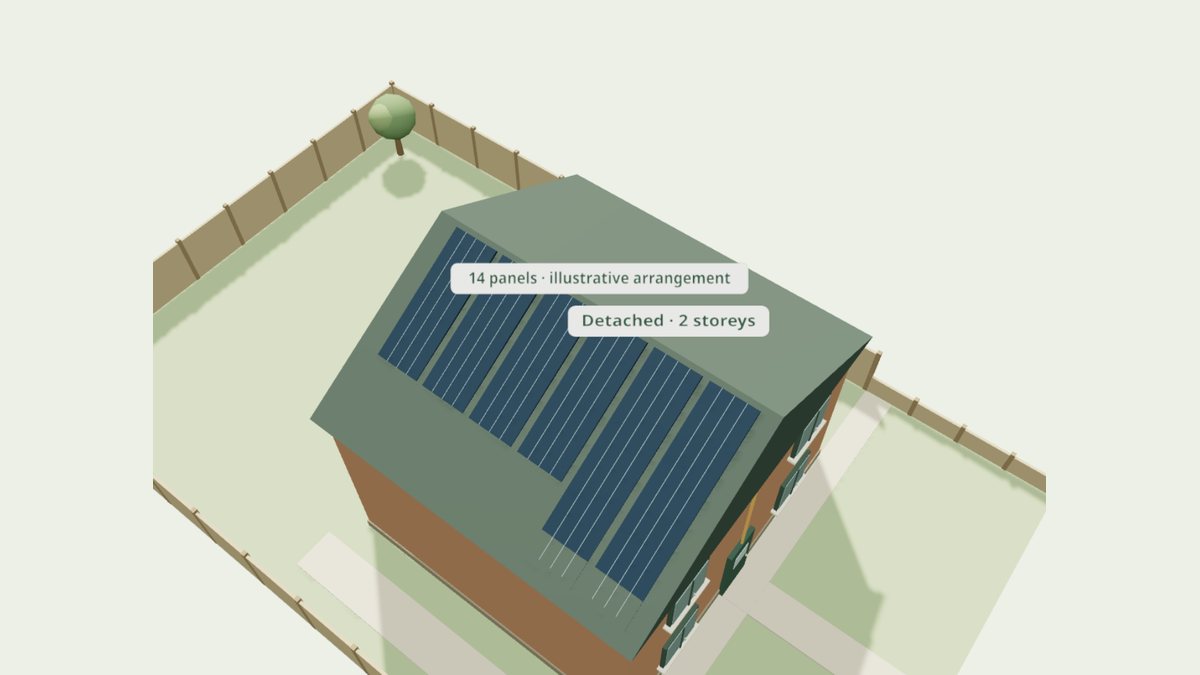
A modern panel is roughly 1.7 × 1.1 m and around 400 – 450 W. Installers keep clear margins from the ridge, eaves and edges, so on a typical semi-detached roof slope you can often fit 8 to 12 panels, or about 3.5 – 5 kWp. Chimneys, roof windows, hips and shading all reduce that.
Orientation matters: in the UK a south-facing slope generates the most over the year, east and west roughly 80% of that, and north-facing slopes much less. The planner works this out from your home’s real position and roof direction.
Do you need planning permission? (England)
Roof-mounted panels on a house are usually permitted development in England, provided that:
- on a pitched roof they stand out no more than 200 mm from the roof surface and don’t go above the highest part of the roof (excluding the chimney);
- the building isn’t listed, and isn’t in the grounds of a listed building or a scheduled monument (these need consent);
- in a conservation area or World Heritage Site, they aren’t on a wall that fronts a road. Check with your council about roofs too.
Getting paid for what you export
- The Smart Export Guarantee (SEG) pays you for electricity you send back to the grid. To qualify, the installation generally needs to be MCS certified, so use an MCS-certified installer.
- Export rates vary a lot between suppliers, and are usually lower than what you pay for electricity, so using more of your own solar power (or adding a battery) usually saves more.
- Your installer should also notify your network operator (DNO) about the system.
Wales, Scotland and Northern Ireland
The 0% VAT rate applies in England, Wales and Scotland. The permitted development conditions above are England’s.
- Wales has its own permitted development rules. They are similar to England’s in many places but not identical, so check with your council before relying on English limits.
- Scotland has separate planning rules, and most building work needs a building warrant from the council’s building standards team before it starts.
- Northern Ireland has its own permitted development order and building regulations, run by local councils.
Before you hire someone
- Use an MCS-certified installer, so you can claim the Smart Export Guarantee.
- Ask for a generation estimate based on your roof direction, pitch and shading.
- Check the quote shows panel, inverter and any battery models, with warranties.
- Confirm scaffolding, DNO notification and certificates are included.
- Check the price shows 0% VAT if installed before 1 April 2027 (Great Britain).
- Compare SEG export rates before choosing a supplier.
Common questions
How much do solar panels cost in the UK in 2026?
Energy Saving Trust estimates, quoted by Which?, put a typical 4.5 kWp home system at around £7,600 installed. Batteries add to this. Installation in Great Britain is zero-rated for VAT until 31 March 2027.
Is there VAT on solar panels?
In England, Wales and Scotland, installing solar panels and batteries in a home is charged at 0% VAT until 31 March 2027, then 5% from 1 April 2027. Northern Ireland is not covered by the GB zero rate.
Do I need planning permission for solar panels?
Usually not for a house in England, if the panels sit no more than 200 mm from the roof and don’t go above the ridge. Listed buildings need consent, and conservation areas have extra limits.
How many solar panels can I fit on a semi-detached house?
Often around 8 to 12 panels on one roof slope, about 3.5 to 5 kWp, depending on the roof size, obstructions and required margins. The planner can estimate this for your roof.
Sources
Figures and rules were checked on 14 October 2026. Prices are published UK ranges, not quotes: get written quotes for your own job.